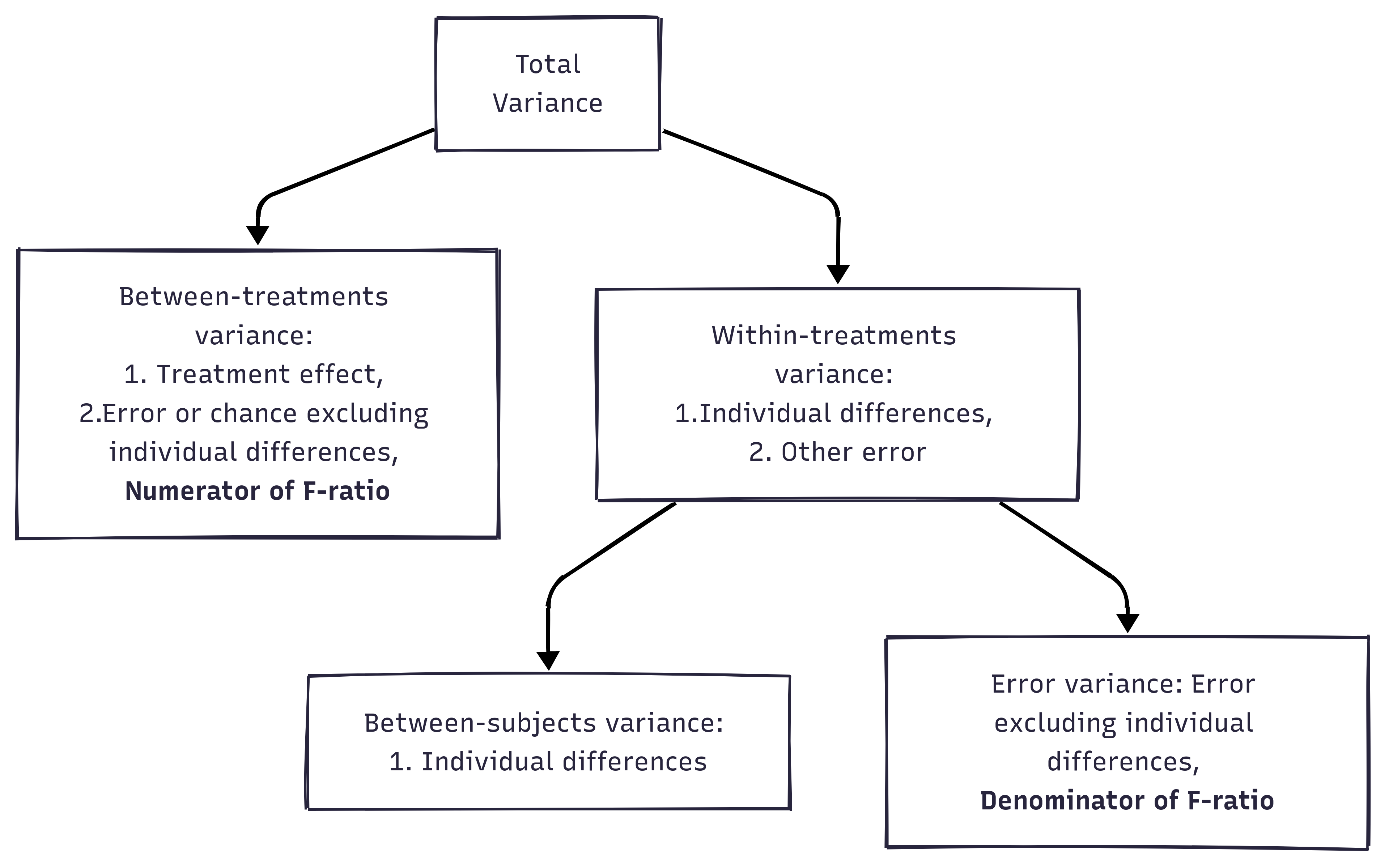
Lecture 11: Repeated Measure ANOVA

Experimental Design in Education

Jihong Zhang*, Ph.D

Educational Statistics and Research Methods (ESRM) Program*

University of Arkansas

2025-04-06

Overview of Lecture 11

  1. Disadvantages and Advantages of Repeated Measure ANOVA
  2. Repeated-measure ANOVA:
    • Random components (What to report)
    • Hypothesis testing
    • Assumptions for RM ANOVA

Question: How about the research scenario when more than two independent variables?

1 Introduction

Big Picture: Longitudinal Study Designs

Repeated measures ANOVA is one member of a much broader family of longitudinal designs — any study that collects data on the same units at multiple time points. These designs appear at two levels:

Between-Subject Longitudinal Studies

Data are collected from different (independent) samples at each wave, tracking population-level change over time rather than individuals.

Examples:

  • TIMSS (Trends in International Mathematics and Science Study) — assesses 4th and 8th graders across countries every 4 years; each wave samples new students, enabling cross-national trend comparisons.
  • PISA (Programme for International Student Assessment) — OECD survey of 15-year-olds across 80+ countries every 3 years; cohorts change each cycle.
  • NAEP (National Assessment of Educational Progress) — U.S. national representative samples at each administration; not the same students longitudinally.

Key feature: Because different individuals are measured each wave, individual trajectories cannot be tracked — only group-level trends.

Within-Subject Longitudinal Studies

The same individuals are followed across time, enabling analysis of individual change trajectories and within-person variability.

Examples:

  • Ecological Momentary Assessment (EMA) — participants report on mood, stress, or behavior multiple times per day via smartphone. Captures intra-individual fluctuations that are invisible in one-shot surveys.
  • Process Data Analysis — log data from computerized tasks (e.g., PISA problem-solving items) record every action with a timestamp, yielding dense within-person sequences.
  • Growth Curve Modeling — panel studies tracking the same students over several years to estimate individual learning trajectories.

Key feature: Because the same person is measured repeatedly, observations are correlated — this is precisely the dependency that Repeated Measures ANOVA (and later, multilevel models) is designed to handle.

Compare to Other Designs

  • When we want to add more independent variables to ANOVA-design,
    1. Blocking Design: 1 independent variable, 1 blocking variable
    2. Factorial Design: N-way ANOVA (e.g., 2-way ANOVA = 2 independent variables)
    3. Repeated Measures ANOVA: 1 independent variable measured only one time, and 1 independent variable measured repeated time points
    4. ANCOVA: 1 independent variable, and 1 covariate (continuous IV!)
    5. Mixed Design

Note. All ANOVA-related designs talked about in this class can handle only one dependent variable; if you want to deal with more than 2 dependent variable, we may consider other research designs…

Procedure of RM ANOVA

  • To conduct the hypothesis test, we follow:

    1. Set the null hypothesis, and the alternative hypothesis
    2. Determine alpha level, and calculate dfs → critical value of test statistics
    3. Calculate the observed value of test statistics
    4. Make the statistical conclusion → (1) critical vs. observed, OR (2) 𝛼 vs. p
    5. Make the research conclusion → research question?
  • Before conducting the hypothesis test, we check:

    1. Independence of observations → !!!ANOVA it NOT robust to violation of this!!!
    2. Normality → ANOVA tends to be relatively robust to non-normality.
    3. Homogeneity of variance → ANOVA can handle the violation of HOV when the group sizes are equal (i.e., balanced) and the group sizes are large enough. Or we can use Welch’s.
  • Independence of the observations:

    1. Measurements from one case in the study are independent of other cases in the study.
    2. If we violate this assumption, we have to do something else!
    • → One of the remedies would be to use “Repeated Measures ANOVA (RM ANOVA)”

2 Types of Repeated Measures Design

What Is RM ANOVA

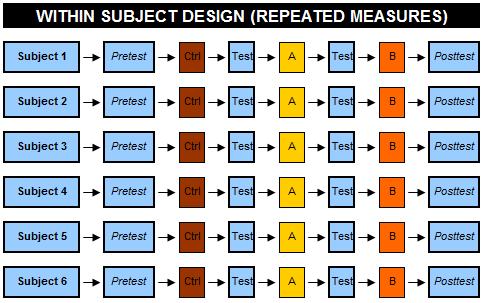
  • When multiple, repeat measurements are made on an experimental unit:
    • The observations can no longer be assumed to be independent.
      • → Result: Correlations in the residual errors among time periods!
      • → The correlations indicate the shared part among the individuals.
    • Not just over time, many other scenarios can result in repeated measures:
      • → Ex: Cross-over design where the treatments themselves are switched on the same experimental unit during the course of the experiment.
      • → In a cross-over design: each person goes through each treatment condition.
      • → Repeated measures are frequently encountered in clinical trials, development of growth models, and situations in which experimental units are difficult to acquire.

Various Repeated Measure Design

First Type of RM ANOVA: Repeated Measure Design

  • Two types of repeated measures are common:
    1. Repeated measures in time: individuals receive a treatment, and then are followed with repeated measures on the response variable over several times.
      • Ex: The dataset might be:
        • For example, Sally is only in the “None” group. She never receives the “daily tutoring” condition.
        • Chi is only in the “daily tutoring” condition.
        • IV: “Tutoring type” can only explain the between-subject variance.
Tutoring Type Time 1 (1st week out) Time 2 (2nd week out) Time 3 (3rd week out)
None Sally
Joe
Montes
Sally
Joe
Montes
Sally
Joe
Montes
Once/week Omar
Fred
Jenny
Omar
Fred
Jenny
Omar
Fred
Jenny
Daily Chi
Lena
Caroline
Chi
Lena
Caroline
Chi
Lena
Caroline

Second Type of RM ANOVA: Cross-Over Design

  • Two types of repeated measures are common:

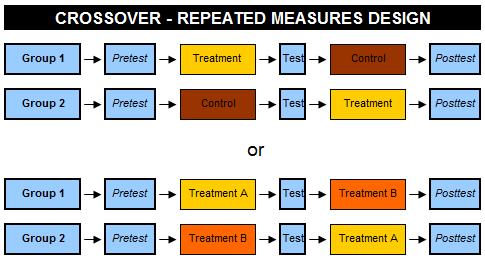
    1. Cross-over Design: alternatively, experiments can involve administering all treatment levels (in a sequence) to each experimental unit.
    • Require a wash-out period between treatment applications to prevent (or minimize) carry-over effects.
      • Carry-over effects occur when the application of one treatment affects the response of the next treatment applied in the cross-over design.
    • The order of treatment administration in a crossover experiment is called a “sequence.”
      • The sequences should be determined a priori and the experimental units are randomized to sequences.
    • Time of a treatment administration is called a “period.”
      • Treatments are designated with capital letters, such as A, B, etc.
    • The most popular crossover design is the 2-sequence, 2-period, 2-treatment crossover design, with sequences AB and BA.
      • Often called the 2 × 2 crossover design.

Cross-Over Design: 2 x 2

  1. Cross-over Design: alternatively, experiments can involve administering all treatment levels (in a sequence) to each experimental unit.

    • 2 × 2 crossover design:
      • Experimental units that are randomized to the AB sequence receive treatment A in the first period and treatment B in the second period.
      • Experimental units that are randomized to the BA sequence receive treatment B in the first period and treatment A in the second period.
    Period 1 Period 2
    Sequence AB A B
    Sequence BA B A

Important

How many potential sequences are for J x J design?

\[ \prod (J, J-1, \cdots,1) \]

Cross-Over Design: 3 x 3

  • Two types of repeated measures are common:

    1. Cross-over Design: alternatively, experiments can involve administering all treatment levels (in a sequence) to each experimental unit.
    • 3 × 3 crossover design:
      • ✅ Consider a 3-treatment, 3-period design
      • ✅ A = no tutoring, B = once/week, C = daily
Period 1 Period 2 Period 3
Sequence ABC A B C
Sequence BCA B C A
Sequence CAB C A B
Sequence ACB A C B
Sequence BAC B A C
Sequence CBA C B A

Carryover Effects Issues

Carryover effects:

  • In a cross-over design, carryover effects refer to the residual effects of a treatment that persist and influence responses in subsequent treatment periods.

  • Since each participant receives multiple treatments in sequence, the outcome measured in a later period may be affected not only by the current treatment but also by the lingering influence of prior treatments.

  • Example:

    • One student was measured three math tests (Math A/B/C). Math A and B has overlapping items with similar difficulty.
    • Consider a 3×3 crossover design where a subject receives treatments A, B, and C across three periods.
      • If the subject receives treatment B in Period 1 and treatment A in Period 2, the effect observed in Period 2 may not reflect the pure effect of A—it may be contaminated by the residual effect of B, thus biasing the estimation of treatment A’s effectiveness.
  • Discussion: Can you think about more carryover effect in your research area?

Problems of Carryover

  • Main disadvantage: carryover effects may be confounded with treatment effects, because these effects cannot be estimated separately.
    • Think about Sequence BCA: You think you are estimating the effect of treatment A, but there is also a bias (or carryover) from the previous treatments to account for.
  • Carryover effects can also bias the interpretation of data analysis, so an investigator should proceed cautiously when implementing a crossover design.
    • So, what do we do? Washout periods can diminish the impact of carryover effects
    • Washout period: time between treatment periods.
  • ✅ These are especially helpful in clinical trials: Instead of immediately stopping and then starting the new treatment, a period of time where the drug is washed out of the patient’s system is used.
    • Ex: educational tests ➔ Subjects may be affected permanently by what they learned during the first period.

3 RM ANOVA Statistical Framework

RM ANOVA Factors

  • As with any ANOVA, repeated measures ANOVA tests the equality of means.
    • But, the statistical approach might differ.
  • Statistical Terminology:
    • When a dependent variable is measured repeatedly for all sampled, this set of conditions is called a within-subjects factor.
      • Time (or trial) is typically used as our within-subject factor.
      • Emotion over time is typically used as our within-subject factor.
      • Self-reported Status is typically used as our within-subject factor.
    • When a dependent variable is measured on independent groups of sample members, where each group is exposed to a different condition, the set of conditions is called a between-subjects factor.
      • ✅ In the previous example, tutoring type would be the between-subject factor.
      • ✅ We think of these as the IVs from our “usual” ANOVAs.
    • When an analysis has both within-subjects factors and between-subjects factors, and considers their interaction effect, it is called a mixed design. (We will talk about it later!)

RM ANOVA Logic

  • The logic behind a repeated measures ANOVA is very similar to that of a between-subjects ANOVA.
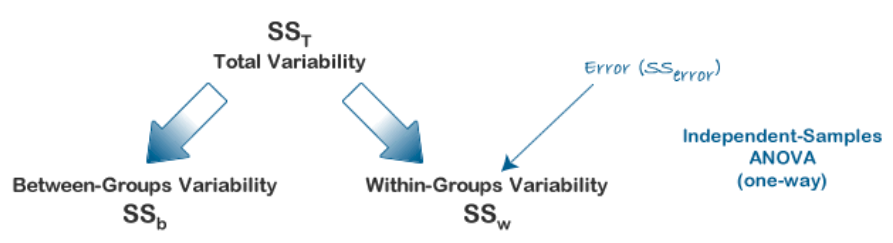
  • Recall that in a between-subjects ANOVA (i.e., the “usual” ANOVA), we partition the total variability into:
    • Model (i.e., between-groups variability; SSModel)
    • Error (i.e., within-groups variability; SSError)

RM ANOVA Logic II

  • In RM ANOVA design, within-group variability (SSw) is used as the error variability (SSError).

    • That said, “Why subjects differ within the same group” is unexplained!
  • The F-statistic is calculated as the ratio of MSModel to MSError:

    Independent ANOVA:
    \[ F = \frac{MS_b}{MS_w} = \frac{MS_b}{MS_{error}} \]

RM ANOVA Logic III

Important

“Why subjects differ within the same group (e.g., treatment/control groups)” can be explained in RM ANOVA!

  • The advantage of a repeated measures ANOVA:

    • ✅ Within-group variability (SSw) is the error variability (SSerror) in an independent (between-subjects) ANOVA.
    • ✅ But, in a repeated measures ANOVA we further partition this error term, reducing its size, and increasing power!
  • A repeated measures ANOVA calculates an F-statistic in a similar way:
    • Repeated Measures ANOVA: \(F = \frac{MS_{conditions}}{MS_{error}}\)

RM ANOVA Logic IV

  • Mathematically, we are partitioning the variability attributable to the differences between groups (SSconditions) and variability within groups (SSw) exactly as we do in a between-subjects (independent) ANOVA.

  • With a repeated measures ANOVA, we are using the same subjects in each group, so we can remove the variability due to the individual differences between subjects, referred to as SSsubjects, from the within-groups variability (SSw).

  • We simply treat each subject as a “block.”

    • ✅ Each subject becomes a level of a factor, called subjects.
    • ✅ Then, we do not care about the interaction between within- and between-subjects.
  • The ability to subtract SSsubjects will leave us with a smaller SSerror term:

    Independent ANOVA: \(SS_{error} = SS_{w}\)

    Repeated Measures ANOVA: \(SS_{error} = SS_{w} - SS_{subjects}\)

4 Case Study: Drug Effect on Canine Blood Histamine

Background: Histamine is an organic nitrogenous compound produced by immune cells (mast cells and basophils) to fight invaders.

  • Researchers are interested in the effect of drug on blood concentration of histamine at 0, 1, 3, and 5 minutes after injection of the drug.
    • Subjects: dogs
    • DV: blood concentration of histamine
    • Within-subject factor: time (4 levels: 0, 1, 3, and 5 minutes)
  • Six dogs, four time points
Dog ID time1 time2 time3 time4 Dog mean
1 10 16 25 26 19.25
2 12 19 27 25 20.75
3 13 20 28 28 22.25
4 12 18 25 15 17.50
5 11 20 26 18 18.75
6 10 22 27 19 19.50
Time mean 11.33 19.17 26.33 21.83 Grand mean = 19.67

Table for RM ANOVA Report

🔴 ANOVA Table of Repeated Measures ANOVA
Component Source Sub-Component SS df MS F
I Between-time
II Within-time Between-Subjects
III Within-time Within-Subjects / Error

Note. Under the repeated measures ANOVA, we can decompose the total variability:

Total variability of DV = “between-time” variability + “within-time” variability

  • “Within-Time” variability = “Between-subjects” variability + “Within-subjects” variability
  • “Within-Subjects” variability is treated as “error”
    • We know outcome differ because of time (consistent time variability over people) or people (consistent people variability over time), what left is unexplained

Between-subjects are useful because we can use it to explain the treatment effects / gender effects (anything relevant to why people different from each other).

Think about “between-time” row in ANOVA table

Question this component answers: Do average histamine levels differ across the four time points?

For each time point, we measure how far its average is from the grand average of all measurements, then multiply by the number of dogs (6). Summing these squared distances gives \(SS_{btime} = 712.96\).

We calculate mean square for between-time as:

\[ MS_{btime} = \frac{SS_{btime}}{df_{btime}} \]

Where:

\[ SS_{btime} = \sum n_{subjects}(\bar{Y}_{time} - \bar{Y}_{grand})^2 = 6(11.33 - 19.67)^2 + \cdots + 6(21.83 - 19.67)^2 = 712.961 \]

\[ df_{btime} = \text{Number of time points} - 1 = 4 - 1 = 3 \]

Thus,

\[ MS_{btime} = \frac{712.96}{3} = 237.65 \]

Data
Dog ID time1 time2 time3 time4 Dog mean
1 10 16 25 26 19.25
2 12 19 27 25 20.75
3 13 20 28 28 22.25
4 12 18 25 15 17.50
5 11 20 26 18 18.75
6 10 22 27 19 19.50
Time means 11.33 19.17 26.33 21.83 Grand Mean = 19.67
ANOVA Table (Partial)
Source SS df MS F
Between-time 712.96 3 237.65
Between-Subjects
Within-time: Error
  • A large \(SS_{btime}\) means histamine levels changed substantially over time — the time effect is strong.
  • The degrees of freedom reflect how many time contrasts are possible: 4 time points → 3 independent comparisons.
  • \(MS_{btime} = 237.65\) is the numerator of the F-statistic for testing the main effect of time.

Think about “between-subjects” row in ANOVA table

Question this component answers: Do some dogs consistently have higher or lower histamine levels than others, regardless of time?

For each dog, we compute its average across all four time points, then measure how far that average is from the grand mean. Multiplying by the number of time points (4) and summing gives \(SS_{bsubjects} = 54.33\).

We calculate mean square for between-subjects (between-dog) as:

\[ MS_{bsubjects} = \frac{SS_{bsubjects}}{df_{bsubjects}} \]

Where:

\[ SS_{bsubjects} = \sum n_{times}(\bar{Y}_i - \bar{Y}_{grand})^2 = 4*(19.25 - 19.67)^2 + \cdots + 4*(19.50 - 19.67)^2 = 54.33 \]

“Click here to see R code”
dog_means <- c(19.25, 20.75, 22.25, 17.50, 18.75, 19.50 )
sum(4 * (dog_means - 19.67)^2)
[1] 54.3336

\[ df_{bsubject} = N_{dogs} - 1 = 6 - 1 = 5 \]

Thus,

\[ MS_{bsubjects} = \frac{54.33}{5} = 10.866 \]

Data
Dog ID time1 time2 time3 time4 Dog mean
1 10 16 25 26 19.25
2 12 19 27 25 20.75
3 13 20 28 28 22.25
4 12 18 25 15 17.50
5 11 20 26 18 18.75
6 10 22 27 19 19.50
Time means 11.33 19.17 26.33 21.83 Grand Mean = 19.67
ANOVA Table (Partial)
Source SS df MS F
Between-time 712.96 3 237.65
Between-Subjects 54.33 5 10.87
Within-time: Error
  • A large \(SS_{bsubjects}\) means individual dogs differ a lot from each other in their baseline histamine levels.
  • This variability is not error — it is systematic and predictable (Dog 3 is simply a higher-histamine dog than Dog 4).
  • By isolating this component, RM ANOVA removes it from the error term, leaving a smaller, cleaner denominator for the F-test.

Think about “Within-time: Error” row in ANOVA table

Question this component answers: What variability is left that cannot be explained by either time or individual dog differences?

Within-time variability captures how much individual dogs’ readings scatter around each time point’s average. For each time point, we look at how far each dog’s measurement is from that time point’s mean. Squaring and summing across all dogs and all time points gives \(SS_{wtime} = 170.33\).

However, part of this within-time spread is simply because some dogs are consistently higher or lower than others — that is the Between-Subjects component (\(SS_{bsubjects} = 54.33\)). We subtract it out, leaving only true random noise:

\[ SS_{error} = SS_{wtime} - SS_{bsubjects} = 170.33 - 54.33 = 116 \]

\[ df_{error} = df_{wtime} - df_{bsubjects} = 20 - 5 = 15 \]

Thus:

\[ MS_{error} = \frac{116}{15} = 7.333 \]

Data
Dog ID time1 time2 time3 time4 Dog mean
1 10 16 25 26 19.25
2 12 19 27 25 20.75
3 13 20 28 28 22.25
4 12 18 25 15 17.50
5 11 20 26 18 18.75
6 10 22 27 19 19.50
Time means 11.33 19.17 26.33 21.83 Grand Mean = 19.67
ANOVA Table (Complete)
Source SS df MS F
Between-time 712.96 3 237.65
Between-Subjects 54.33 5 10.87
Within-time: Error 116.00 15 7.33
  • Within-time total (\(SS_{wtime} = 170.33\)) is the overarching pool — it is the sum of Between-Subjects and Error.
  • After removing Between-Subjects, \(MS_{error} = 7.33\) is the denominator of the F-statistic: \(F = 237.65 / 7.33 = 30.73\).
  • This is much smaller than using \(MS_{wtime} = 8.52\) would have been — giving a larger, more powerful F-statistic.
  • In plain terms: RM ANOVA rewards you for using the same dogs repeatedly, because you can explain away the noise that comes from dogs simply being different from each other.

Validate Formulas with R

library(tidyverse)

dat_wide <- tribble(
  ~ID, ~time1, ~time2, ~time3, ~time4,
  1,   10,     16,     25,     26,
  2,   12,     19,     27,     25,
  3,   13,     20,     28,     28,
  4,   12,     18,     25,     15,
  5,   11,     20,     26,     18,
  6,   10,     22,     27,     19
)

dat_long <- dat_wide |>
  pivot_longer(starts_with("time"), names_to = "Time", values_to = "Y") |>
  mutate(ID = factor(ID), Time = factor(Time))

grand_mean <- mean(dat_long$Y)
n_subjects <- n_distinct(dat_long$ID)   # 6 dogs
n_times    <- n_distinct(dat_long$Time) # 4 time points
time_means <- dat_long |> group_by(Time) |> summarise(mean_Y = mean(Y))

SS_btime <- n_subjects * sum((time_means$mean_Y - grand_mean)^2)
df_btime <- n_times - 1
MS_btime <- SS_btime / df_btime

cat("SS_btime =", round(SS_btime, 3), "\n")
SS_btime = 713 
cat("df_btime =", df_btime, "\n")
df_btime = 3 
cat("MS_btime =", round(MS_btime, 3), "\n")
MS_btime = 237.667 

Expected: \(SS_{btime} = 712.96\), \(df = 3\), \(MS = 237.65\)

subject_means <- dat_long |> group_by(ID) |> summarise(mean_Y = mean(Y))

SS_bsubjects <- n_times * sum((subject_means$mean_Y - grand_mean)^2)
df_bsubjects <- n_subjects - 1
MS_bsubjects <- SS_bsubjects / df_bsubjects

cat("SS_bsubjects =", round(SS_bsubjects, 3), "\n")
SS_bsubjects = 54.333 
cat("df_bsubjects =", df_bsubjects, "\n")
df_bsubjects = 5 
cat("MS_bsubjects =", round(MS_bsubjects, 3), "\n")
MS_bsubjects = 10.867 

Expected: \(SS_{bsubjects} = 54.33\), \(df = 5\), \(MS = 10.87\)

SS_wtime <- dat_long |>
  left_join(time_means, by = "Time") |>
  summarise(SS = sum((Y - mean_Y)^2)) |>
  pull(SS)

df_wtime <- n_subjects * (n_times - 1) # (6-1)*4 = 20

SS_error <- SS_wtime - SS_bsubjects
df_error <- df_wtime - df_bsubjects
MS_error <- SS_error / df_error

cat("SS_wtime  =", round(SS_wtime, 3),  "| df =", df_wtime,  "\n")
SS_wtime  = 170.333 | df = 18 
cat("SS_error  =", round(SS_error, 3),  "| df =", df_error,  "\n")
SS_error  = 116 | df = 13 
cat("MS_error  =", round(MS_error, 3), "\n")
MS_error  = 8.923 

Expected: \(SS_{wtime} = 170.33\), \(SS_{error} = 116\), \(df_{error} = 15\), \(MS_{error} = 7.33\)

model <- aov(Y ~ Time + Error(ID/Time), data = dat_long)
summary(model)

Error: ID
          Df Sum Sq Mean Sq F value Pr(>F)
Residuals  5  54.33   10.87               

Error: ID:Time
          Df Sum Sq Mean Sq F value   Pr(>F)    
Time       3    713  237.67   30.73 1.19e-06 ***
Residuals 15    116    7.73                     
---
Signif. codes:  0 '***' 0.001 '**' 0.01 '*' 0.05 '.' 0.1 ' ' 1

aov() with Error(ID/Time) partitions all three components — between-subjects (stratum ID), between-time, and within-subjects error (stratum ID:Time) — matching the hand-calculated values above.

Hypothesis Test Procedure

✅ Main Effect of Time:

Research Question:
Does histamine concentration change over time?
(That is, does mean histamine concentration differ across the four time points?)

(Histamine is a chemical your immune system releases.)

Null Hypothesis:
\[ H_0: \mu_{time1} = \mu_{time2} = \mu_{time3} = \mu_{time4} \]

ANOVA Table

Source SS df MS F
Between-time 712.96 3 237.65 237.65 / 7.33 = 30.73
Between-Subjects 54.33 5 10.87 10.87 / 7.33 = 1.48
Within-time: Error 116.00 15 7.33

Conclusion

  • Under \(\alpha = 0.05\), the critical value for \(df_{time} = 3\) and \(df_{error} = 15\) from the F-table is:
    \(F_{crit} = 3.29\)

  • Since the observed F-value for the time effect is 30.73, which exceeds the critical value of 3.29:

    • ✅ We reject the null hypothesis.
    • ✅ There is a significant main effect of time.

Conclusion:
There is a significant difference in histamine concentration across the four time points.

5 Assumptions & Sphericity

Repeated Measures ANOVA: Assumption I

🔍 Before conducting the hypothesis test, we check:

  1. Independence of observations
    !!! ANOVA is NOT robust to violation of this !!!

  2. Normality
    ➔ ANOVA tends to be relatively robust to non-normality.

  3. Homogeneity of variance (HOV)
    ➔ ANOVA can handle HOV violations when:

    • Group sizes are equal (i.e., balanced)
    • Group sizes are large enough
      ➔ Otherwise, consider using Welch’s ANOVA

✅ Independence of the Observations:

  • Measurements from one case in the study are independent of other cases in the study.
  • If we violate this assumption, we have to do something else!
    ➔ One remedy would be to use repeated measures ANOVA.

❓ Then, which assumption should we check for repeated measures ANOVA?

Repeated Measures ANOVA: Assumption II

🔍 Before conducting the hypothesis test, we check:

  1. Independency
    Do not need to check! (in repeated measures designs)

  2. Normality
    ➔ The dependent variable (DV) at each level of the independent variable(s) should be approximately normally distributed.
    ➔ However, ANOVA tends to be relatively robust to non-normality.

  3. Instead of HOV (Homogeneity of Variance)
    ➔ We should check “Sphericity”

🧠 Sphericity

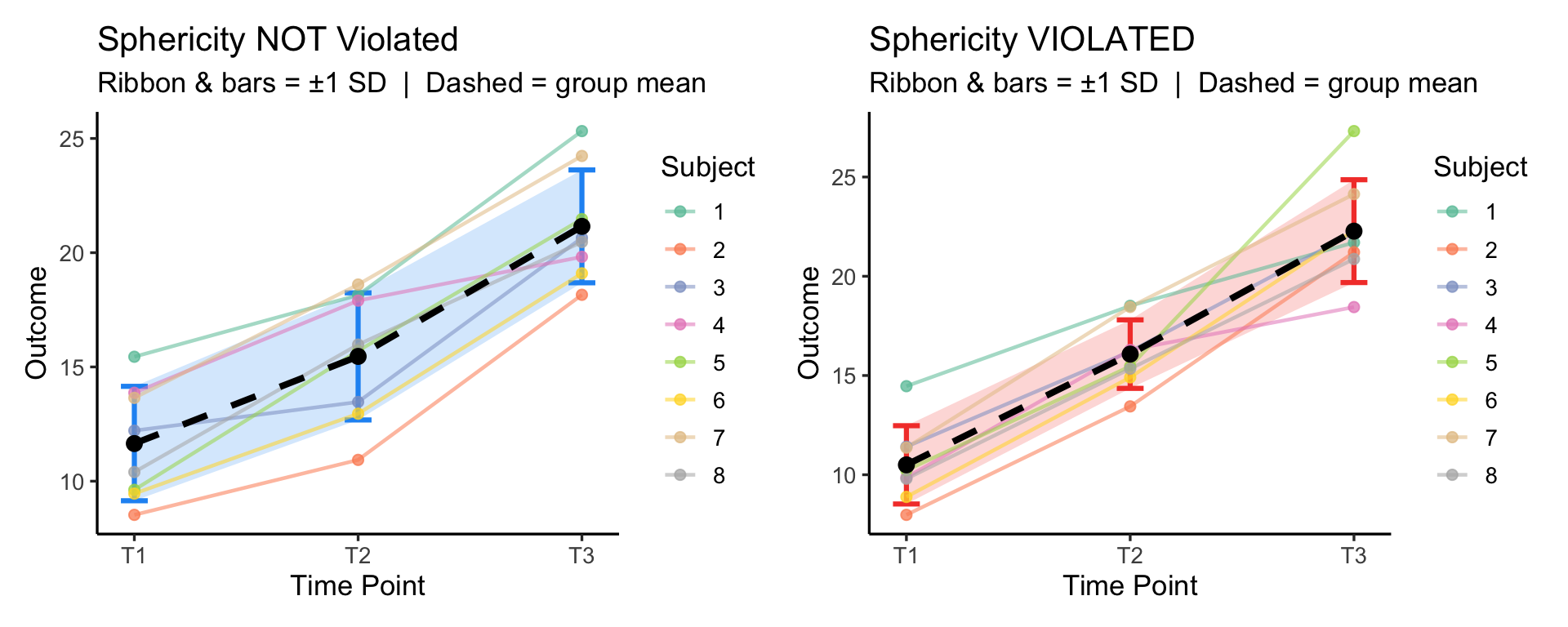
  • The concept of sphericity is the repeated measures equivalent of homogeneity of variances.
  • Sphericity is the condition where the variances of the differences between all combinations of related groups (levels) are equal.
  • Violation of sphericity occurs when the variances of the differences between all combinations of related groups are not equal.
  • Testing for sphericity
    • is an option in PROC GLM using Mauchly’s Test for Sphericity.
    • In R, testing for sphericity in a repeated measures ANOVA is typically conducted using car::Anova() on a multivariate lm() object, which includes Mauchly’s Test of Sphericity and Greenhouse-Geisser / Huynh-Feldt corrections.

Sphericity Illustration

Dog ID time1 time2 time3 t1 - t2 t1 - t3 t2 - t3
1 10 16 25 -6 -15 -9
2 12 19 27 -7 -15 -8
3 13 20 28 -7 -15 -8
4 12 18 25 -6 -13 -7
5 11 20 26 -9 -15 -6
6 10 22 27 -12 -17 -5
Variance 5.367 1.6 2.167
Click to see code
library(tidyverse)
library(plotly)
dat_wide <- tribble(
  ~ID, ~T1, ~T2, ~T3,
  1, 10, 16, 25,
  2, 12, 19, 27,
  3, 13, 20, 28,
  4, 12, 18, 25,
  5, 11, 20, 26,
  6, 10, 22, 27
)
dat_long <- dat_wide |>
  pivot_longer(starts_with("T"), names_to = "Time", values_to = "Y") |>
  mutate(Time = factor(Time, levels = paste0("T",1:3)),
         ID = factor(ID, levels = 1:6))
dat_long |>
  plot_ly(x=~Time, y=~Y) |>
  add_markers(color=~ID) |>
  add_lines(color=~ID)

This table presents:

  • The raw time-point measurements (time1, time2, time3)
  • Pairwise difference scores (t1 - t2, t1 - t3, t2 - t3)
  • Variance of each set of pairwise differences at the bottom (used to assess sphericity)

We are concerned with these variances for “sphericity”

✅ Step-by-step: Testing Sphericity in R

car::Anova() requires a wide-format response matrix — one row per subject, one column per time point.

library(car)

# Main case study: 6 dogs × 4 time points
dat_wide_main <- tribble(
  ~ID, ~time1, ~time2, ~time3, ~time4,
  1,   10,     16,     25,     26,
  2,   12,     19,     27,     25,
  3,   13,     20,     28,     28,
  4,   12,     18,     25,     15,
  5,   11,     20,     26,     18,
  6,   10,     22,     27,     19
)

resp <- dat_wide_main |>
  select(time1, time2, time3, time4) |>
  as.matrix()

resp
     time1 time2 time3 time4
[1,]    10    16    25    26
[2,]    12    19    27    25
[3,]    13    20    28    28
[4,]    12    18    25    15
[5,]    11    20    26    18
[6,]    10    22    27    19
# Intercept-only multivariate lm: each column is a repeated measure
mlm <- lm(resp ~ 1)

# Declare the within-subject factor
idata   <- data.frame(Time = factor(paste0("time", 1:4)))
idesign <- ~ Time

# Repeated measures ANOVA — includes sphericity tests automatically
result <- Anova(mlm, idata = idata, idesign = idesign, type = "III")
# multivariate = FALSE → univariate (sphericity-adjusted) table
summary(result, multivariate = FALSE)

Univariate Type III Repeated-Measures ANOVA Assuming Sphericity

            Sum Sq num Df Error SS den Df F value    Pr(>F)    
(Intercept) 9282.7      1   54.333      5 854.233 8.789e-07 ***
Time         713.0      3  116.000     15  30.733 1.192e-06 ***
---
Signif. codes:  0 '***' 0.001 '**' 0.01 '*' 0.05 '.' 0.1 ' ' 1


Mauchly Tests for Sphericity

     Test statistic    p-value
Time        0.00128 0.00025656


Greenhouse-Geisser and Huynh-Feldt Corrections
 for Departure from Sphericity

      GG eps Pr(>F[GG])   
Time 0.40219   0.001161 **
---
Signif. codes:  0 '***' 0.001 '**' 0.01 '*' 0.05 '.' 0.1 ' ' 1

        HF eps  Pr(>F[HF])
Time 0.4603901 0.000586618

The summary prints three sections:

  1. Mauchly’s Test of Sphericity — W statistic and p-value
  2. Greenhouse-Geisser corrected F-test (always safe)
  3. Huynh-Feldt corrected F-test (less conservative when ε > 0.75)
Test Interpretation
Mauchly’s Test (p > .05) Sphericity holds — use standard F-statistic
Mauchly’s Test (p < .05) Sphericity violated — use corrected F-statistics

If violated, choose the correction by epsilon (ε):

  • ε ≤ 0.75 → use Greenhouse-Geisser (more conservative)
  • ε > 0.75 → use Huynh-Feldt (less conservative)

Mauchly’s test indicated that the assumption of sphericity had not been violated, W = 0.407, p = .165. We can use standard F-test.

Sphericity: Violated vs. Not Violated

Click to see R code
library(tidyverse)
library(patchwork)

set.seed(42)
n <- 8
subject_fx <- rnorm(n, 0, 2.5)  # shared between-subject effect

# --- Sphericity NOT violated ---
# Residual noise is similar at every time point → equal variance of differences
no_viol_wide <- tibble(
  ID = factor(1:n),
  T1 = subject_fx + rnorm(n, 10, 1),
  T2 = subject_fx + rnorm(n, 15, 1),
  T3 = subject_fx + rnorm(n, 20, 1)
)

# --- Sphericity violated ---
# Noise is tiny at T2 but large at T3 → variance of T3-T1 >> variance of T2-T1
viol_wide <- tibble(
  ID = factor(1:n),
  T1 = subject_fx + rnorm(n, 10, 1),
  T2 = subject_fx + rnorm(n, 15, 0.4),
  T3 = subject_fx + rnorm(n, 20, 4.0)
)

to_long <- function(df) {
  df |>
    pivot_longer(T1:T3, names_to = "Time", values_to = "Y") |>
    mutate(Time_num = as.integer(factor(Time, levels = c("T1", "T2", "T3"))))
}

no_viol <- to_long(no_viol_wide)
viol    <- to_long(viol_wide)

plot_sph <- function(dat, title, shadow_col) {
  means <- dat |>
    group_by(Time, Time_num) |>
    summarise(mean_Y = mean(Y), sd_Y = sd(Y), .groups = "drop")

  ggplot(dat, aes(x = Time_num, y = Y)) +
    # Shaded ribbon: mean ± 1 SD connects across time points
    geom_ribbon(
      data = means,
      aes(x = Time_num, y = mean_Y,
          ymin = mean_Y - sd_Y, ymax = mean_Y + sd_Y, group = 1),
      fill = shadow_col, alpha = 0.20, inherit.aes = FALSE
    ) +
    # Error bars at each time point to emphasise the SD width
    geom_errorbar(
      data = means,
      aes(x = Time_num, ymin = mean_Y - sd_Y, ymax = mean_Y + sd_Y),
      width = 0.12, color = shadow_col, linewidth = 1.1, inherit.aes = FALSE
    ) +
    # Individual subject trajectories
    geom_line(aes(group = ID, color = ID), alpha = 0.55, linewidth = 0.8) +
    geom_point(aes(color = ID), size = 2, alpha = 0.75) +
    # Group mean trajectory
    geom_line(
      data = means, aes(x = Time_num, y = mean_Y, group = 1),
      color = "black", linewidth = 1.4, linetype = "dashed", inherit.aes = FALSE
    ) +
    geom_point(
      data = means, aes(x = Time_num, y = mean_Y),
      color = "black", size = 3, inherit.aes = FALSE
    ) +
    scale_x_continuous(breaks = 1:3, labels = c("T1", "T2", "T3")) +
    scale_color_brewer(palette = "Set2") +
    labs(
      title    = title,
      subtitle = "Ribbon & bars = ±1 SD  |  Dashed = group mean",
      x = "Time Point", y = "Outcome", color = "Subject"
    ) +
    theme_classic(base_size = 13) +
    theme(legend.position = "right")
}

p1 <- plot_sph(no_viol, "Sphericity NOT Violated",  "#2196F3")
p2 <- plot_sph(viol,    "Sphericity VIOLATED",      "#F44336")

p1 + p2

Key intuition:

  • Not violated — each subject’s trajectory shifts by roughly the same amount between any two time points. The spread of difference scores (e.g., T2 − T1, T3 − T2) is similar across all pairs.
  • Violated — the gap between time points varies wildly across subjects for some pairs but not others. The variance of T3 − T1 is much larger than the variance of T2 − T1, breaking the equal-variance-of-differences requirement.

📌 Report Between-Subject Variability (Random effects)

car::Anova() with summary(result, multivariate = FALSE) directly exposes between-subject variability in its output. Each row in the univariate summary contains both the effect SS and its corresponding Error SS — the error term for that stratum:

Row in output Effect SS Error SS What it is
(Intercept) grand mean effect SS_subjects Between-subjects variability
Time time effect SS_error Within-subjects error

✅ Reading Between-Subject SS from car::Anova()

library(car)

# Use the main case study (4 time points) to match hand-calculated values
dat_wide_main <- tribble(
  ~ID, ~time1, ~time2, ~time3, ~time4,
  1,   10,     16,     25,     26,
  2,   12,     19,     27,     25,
  3,   13,     20,     28,     28,
  4,   12,     18,     25,     15,
  5,   11,     20,     26,     18,
  6,   10,     22,     27,     19
)

resp   <- dat_wide_main |> select(time1, time2, time3, time4) |> as.matrix()
mlm    <- lm(resp ~ 1)
idata  <- data.frame(Time = factor(paste0("time", 1:4)))
result <- Anova(mlm, idata = idata, idesign = ~Time, type = "III")

summary(result, multivariate = FALSE)

Univariate Type III Repeated-Measures ANOVA Assuming Sphericity

            Sum Sq num Df Error SS den Df F value    Pr(>F)    
(Intercept) 9282.7      1   54.333      5 854.233 8.789e-07 ***
Time         713.0      3  116.000     15  30.733 1.192e-06 ***
---
Signif. codes:  0 '***' 0.001 '**' 0.01 '*' 0.05 '.' 0.1 ' ' 1


Mauchly Tests for Sphericity

     Test statistic    p-value
Time        0.00128 0.00025656


Greenhouse-Geisser and Huynh-Feldt Corrections
 for Departure from Sphericity

      GG eps Pr(>F[GG])   
Time 0.40219   0.001161 **
---
Signif. codes:  0 '***' 0.001 '**' 0.01 '*' 0.05 '.' 0.1 ' ' 1

        HF eps  Pr(>F[HF])
Time 0.4603901 0.000586618

The Error SS on the (Intercept) row = \(SS_{subjects}\) (between-subject variability). The Error SS on the Time row = \(SS_{error}\) (within-subject error used in F-test).

uni <- summary(result, multivariate = FALSE)$univariate.tests

# Between-subjects SS = error SS of the intercept stratum
SS_between_subjects <- uni["(Intercept)", "Error SS"]

# Within-subjects error SS = error SS of the Time effect
SS_within_error <- uni["Time", "Error SS"]

cat("SS_between_subjects =", round(SS_between_subjects, 3), "\n")  # expect 54.33
SS_between_subjects = 54.333 
cat("SS_within_error     =", round(SS_within_error, 3),     "\n")  # expect 116.00
SS_within_error     = 116 
Component Available from car::Anova() How to Obtain
Between-subjects ✅ Yes uni["(Intercept)", "Error SS"]
Within-subjects error ✅ Yes uni["Time", "Error SS"]

6 Discussion: Extending the Case Study

What If Dogs Were Randomized to Treatment vs. Control?

Recall the original study: six dogs, histamine measured at four time points after drug injection. Now suppose the six dogs were randomly assigned to two groups before the study began:

  • Control (Dogs 1–3): received a placebo injection
  • Treatment (Dogs 4–6): received the active drug

Discussion question: How does adding a between-subjects group factor change the analysis? What new effects can we now test?

Updated Data

library(tidyverse)

dat_mixed <- tribble(
  ~ID, ~Group,       ~time1, ~time2, ~time3, ~time4,
  1,   "Control",    10,     16,     25,     26,
  2,   "Control",    12,     19,     27,     25,
  3,   "Control",    13,     20,     28,     28,
  4,   "Treatment",  12,     18,     25,     15,
  5,   "Treatment",  11,     20,     26,     18,
  6,   "Treatment",  10,     22,     27,     19
) |>
  mutate(ID = factor(ID), Group = factor(Group))

dat_mixed_long <- dat_mixed |>
  pivot_longer(starts_with("time"), names_to = "Time", values_to = "Y") |>
  mutate(Time = factor(Time, levels = paste0("time", 1:4)),
         Time_num = as.integer(Time))

dat_mixed_long
# A tibble: 24 × 5
   ID    Group   Time      Y Time_num
   <fct> <fct>   <fct> <dbl>    <int>
 1 1     Control time1    10        1
 2 1     Control time2    16        2
 3 1     Control time3    25        3
 4 1     Control time4    26        4
 5 2     Control time1    12        1
 6 2     Control time2    19        2
 7 2     Control time3    27        3
 8 2     Control time4    25        4
 9 3     Control time1    13        1
10 3     Control time2    20        2
# ℹ 14 more rows

Visualization

Click to see R code
library(patchwork)

group_means <- dat_mixed_long |>
  group_by(Group, Time, Time_num) |>
  summarise(mean_Y = mean(Y), sd_Y = sd(Y), .groups = "drop")

# Individual trajectories + group mean ribbons
p_mixed <- ggplot(dat_mixed_long, aes(x = Time_num, y = Y)) +
  geom_ribbon(
    data = group_means,
    aes(x = Time_num, y = mean_Y,
        ymin = mean_Y - sd_Y, ymax = mean_Y + sd_Y,
        fill = Group, group = Group),
    alpha = 0.15, inherit.aes = FALSE
  ) +
  geom_line(aes(group = ID, color = Group), alpha = 0.5, linewidth = 0.8) +
  geom_point(aes(color = Group), size = 2, alpha = 0.8) +
  geom_line(
    data = group_means,
    aes(x = Time_num, y = mean_Y, color = Group, group = Group),
    linewidth = 1.5, linetype = "dashed", inherit.aes = FALSE
  ) +
  geom_point(
    data = group_means,
    aes(x = Time_num, y = mean_Y, color = Group),
    size = 3.5, inherit.aes = FALSE
  ) +
  scale_x_continuous(breaks = 1:4,
                     labels = paste0("time", 1:4)) +
  scale_color_manual(values = c(Control = "#2196F3", Treatment = "#F44336")) +
  scale_fill_manual(values  = c(Control = "#2196F3", Treatment = "#F44336")) +
  labs(
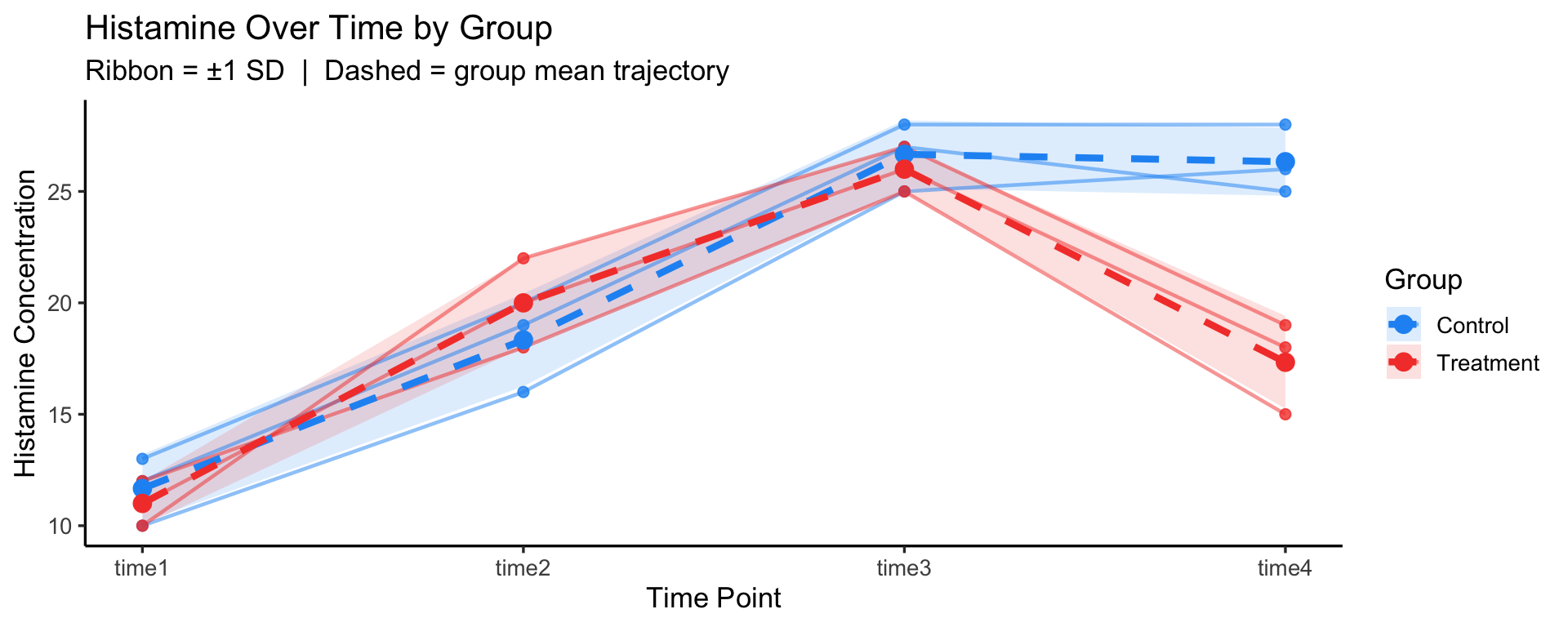
    title    = "Histamine Over Time by Group",
    subtitle = "Ribbon = ±1 SD  |  Dashed = group mean trajectory",
    x = "Time Point", y = "Histamine Concentration",
    color = "Group", fill = "Group"
  ) +
  theme_classic(base_size = 13)

p_mixed

Your Answer

Before reading ahead — what effects should we test?

Answer

This is a Mixed Design (Split-Plot) ANOVA — it combines:

Factor Type Levels
Group Between-subjects Control, Treatment
Time Within-subjects time1, time2, time3, time4

Three effects can now be tested:

  1. Main effect of Time — does histamine change across the four time points, averaged over both groups? (same question as before)
  2. Main effect of Group — do treatment and control dogs differ in their overall (averaged across time) histamine level?
  3. Group × Time interaction — does the trajectory of histamine change over time differ between groups? (This is usually the most scientifically interesting question.)

In R:

model_mixed <- aov(Y ~ Group * Time + Error(ID/Time), data = dat_mixed_long)
summary(model_mixed)

Error: ID
          Df Sum Sq Mean Sq F value Pr(>F)
Group      1  28.17  28.167   4.306  0.107
Residuals  4  26.17   6.542               

Error: ID:Time
           Df Sum Sq Mean Sq F value   Pr(>F)    
Time        3  713.0  237.67  166.14 4.90e-10 ***
Group:Time  3   98.8   32.94   23.03 2.88e-05 ***
Residuals  12   17.2    1.43                     
---
Signif. codes:  0 '***' 0.001 '**' 0.01 '*' 0.05 '.' 0.1 ' ' 1
  • Group is tested against the between-subjects error (MS among dogs within groups)
  • Time and Group:Time are tested against the within-subjects error (MS of residuals after removing dog and time effects)

Looking at the plot: the two group means diverge at time4 — control dogs maintain high histamine while treatment dogs drop back. This crossing/diverging pattern is a visual cue for a potential Group × Time interaction, suggesting the drug suppresses the late-phase histamine response.

What If Time 3 Is the Intervention Session?

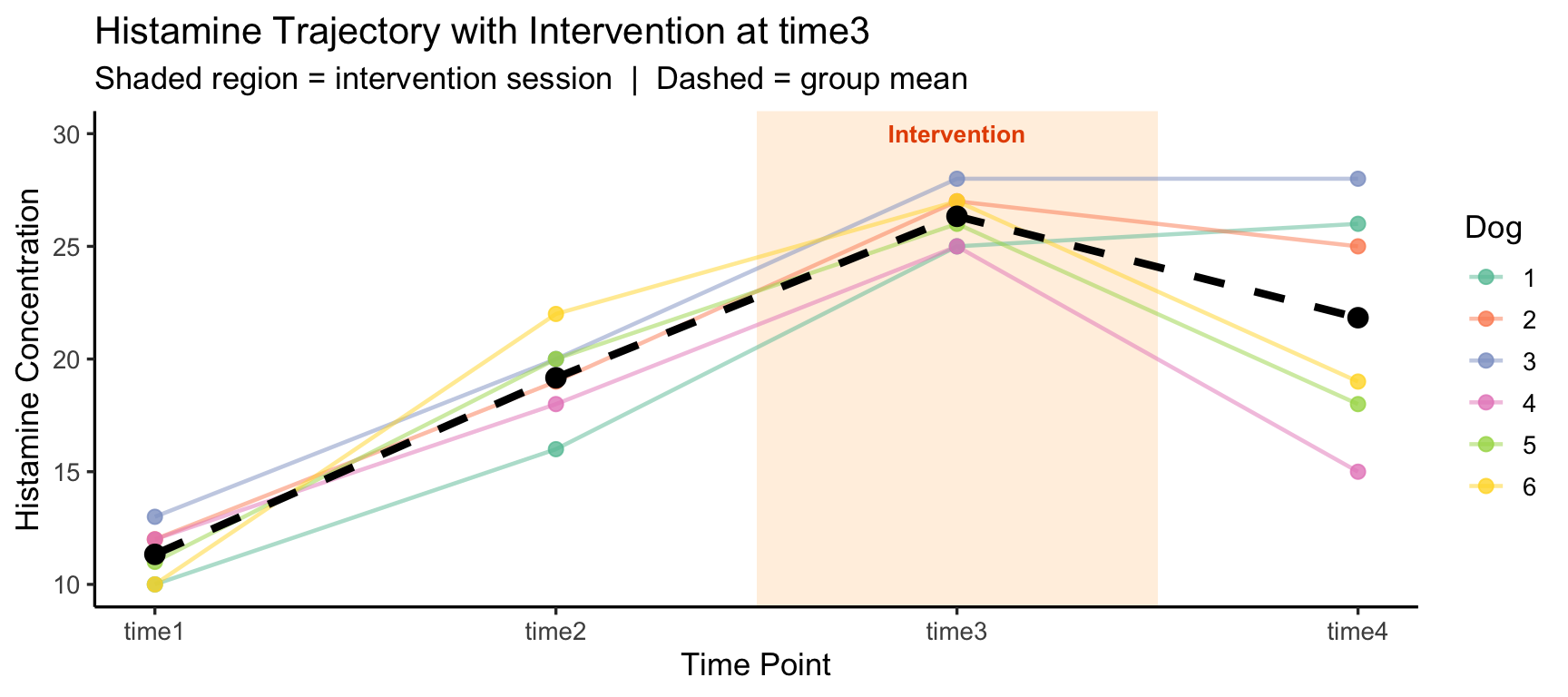
In the original study, all four time points are passive measurements after a single injection. But now suppose time3 is not a measurement — it is when the intervention (drug injection) occurs:

  • time1, time2: baseline measurements before the intervention
  • time3: intervention session (drug administered)
  • time4: post-intervention measurement

Discussion question: How does treating time3 as an intervention point change how we interpret the data and what comparisons matter most?

Why This Changes the Analysis

The within-subjects factor Time now has a qualitative break — the first two time points are a pre-intervention baseline and the last is a post-intervention outcome. Simply testing a main effect of Time conflates the baseline trend with the intervention effect.

A more targeted analysis would compare:

Contrast Formula Question
Pre-trend time3 − time1 Was histamine already rising across the baseline period?
Intervention effect time4 − time3 Did histamine change immediately after the injection session?
DiD (time4 − time3) − (time3 − time1) Does the post-injection change exceed the natural pre-trend?

Visualization

Click to see R code
library(tidyverse)

dat_intervention <- tribble(
  ~ID, ~time1, ~time2, ~time3, ~time4,
  1,   10,     16,     25,     26,
  2,   12,     19,     27,     25,
  3,   13,     20,     28,     28,
  4,   12,     18,     25,     15,
  5,   11,     20,     26,     18,
  6,   10,     22,     27,     19
) |>
  pivot_longer(starts_with("time"), names_to = "Time", values_to = "Y") |>
  mutate(Time = factor(Time, levels = paste0("time", 1:4)),
         Time_num = as.integer(Time),
         Phase = case_when(
           Time_num <= 2 ~ "Pre-Intervention",
           Time_num == 3 ~ "Intervention",
           Time_num == 4 ~ "Post-Intervention"
         ) |> factor(levels = c("Pre-Intervention", "Intervention", "Post-Intervention")),
         ID = factor(ID))

means_int <- dat_intervention |>
  group_by(Time, Time_num) |>
  summarise(mean_Y = mean(Y), .groups = "drop")

ggplot(dat_intervention, aes(x = Time_num, y = Y)) +
  # Shade the intervention time point
  annotate("rect", xmin = 2.5, xmax = 3.5, ymin = -Inf, ymax = Inf,
           fill = "#FF9800", alpha = 0.15) +
  annotate("text", x = 3, y = 30, label = "Intervention", color = "#E65100",
           size = 3.5, fontface = "bold") +
  geom_line(aes(group = ID, color = ID), alpha = 0.5, linewidth = 0.8) +
  geom_point(aes(color = ID), size = 2.5, alpha = 0.8) +
  geom_line(data = means_int, aes(x = Time_num, y = mean_Y, group = 1),
            color = "black", linewidth = 1.5, linetype = "dashed",
            inherit.aes = FALSE) +
  geom_point(data = means_int, aes(x = Time_num, y = mean_Y),
             color = "black", size = 3.5, inherit.aes = FALSE) +
  scale_x_continuous(breaks = 1:4, labels = paste0("time", 1:4)) +
  scale_color_brewer(palette = "Set2") +
  labs(title = "Histamine Trajectory with Intervention at time3",
       subtitle = "Shaded region = intervention session  |  Dashed = group mean",
       x = "Time Point", y = "Histamine Concentration", color = "Dog") +
  theme_classic(base_size = 13)
Your Answer

Before reading — how would you re-frame the hypothesis tests given this design?

Answer

The key shift: time3 should not be treated as just another within-subjects level — it marks a design boundary between baseline and outcome phases.

Recommended approach — planned contrasts instead of omnibus F:

library(tidyverse)

# Compute the two key contrasts per dog
contrasts_df <- dat_intervention |>
  select(ID, Time, Y) |>
  pivot_wider(names_from = Time, values_from = Y) |>
  mutate(
    pre_trend           = time3 - time1,  # baseline drift up to intervention
    intervention_effect = time4 - time3,  # post vs intervention session
    did                 = intervention_effect - pre_trend  # difference-in-differences
  )

contrasts_df |> select(ID, pre_trend, intervention_effect, did)
# A tibble: 6 × 4
  ID    pre_trend intervention_effect   did
  <fct>     <dbl>               <dbl> <dbl>
1 1            15                   1   -14
2 2            15                  -2   -17
3 3            15                   0   -15
4 4            13                 -10   -23
5 5            15                  -8   -23
6 6            17                  -8   -25

Test 1 — Is the pre-intervention trend significantly different from zero?

t.test(contrasts_df$pre_trend, mu = 0)

    One Sample t-test

data:  contrasts_df$pre_trend
t = 29.047, df = 5, p-value = 9.063e-07
alternative hypothesis: true mean is not equal to 0
95 percent confidence interval:
 13.67256 16.32744
sample estimates:
mean of x 
       15 

Test 2 — Is there a significant intervention effect (time4 vs time3)?

t.test(contrasts_df$intervention_effect, mu = 0)

    One Sample t-test

data:  contrasts_df$intervention_effect
t = -2.3342, df = 5, p-value = 0.06686
alternative hypothesis: true mean is not equal to 0
95 percent confidence interval:
 -9.4557369  0.4557369
sample estimates:
mean of x 
     -4.5 

Test 3 — Difference-in-differences: does the intervention effect exceed the pre-trend?

t.test(contrasts_df$did, mu = 0)

    One Sample t-test

data:  contrasts_df$did
t = -10.115, df = 5, p-value = 0.0001618
alternative hypothesis: true mean is not equal to 0
95 percent confidence interval:
 -24.45574 -14.54426
sample estimates:
mean of x 
    -19.5 

Visualise the contrasts per dog:

Click to see R code
contrasts_df |>
  select(ID, pre_trend, intervention_effect, did) |>
  pivot_longer(-ID, names_to = "Contrast", values_to = "Value") |>
  mutate(Contrast = factor(Contrast,
    levels = c("pre_trend", "intervention_effect", "did"),
    labels = c("Pre-trend\n(time3 − time1)",
               "Intervention effect\n(time4 − time3)",
               "DiD\n(effect − trend)"))) |>
  ggplot(aes(x = Contrast, y = Value, color = ID, group = ID)) +
  geom_hline(yintercept = 0, linetype = "dashed", color = "grey50") +
  geom_line(alpha = 0.4, linewidth = 0.8) +
  geom_point(size = 3) +
  stat_summary(aes(group = 1), fun = mean, geom = "point",
               shape = 18, size = 5, color = "black") +
  stat_summary(aes(group = 1), fun = mean, geom = "line",
               linewidth = 1.2, color = "black", linetype = "dashed") +
  scale_color_brewer(palette = "Set2") +
  labs(title = "Planned Contrasts per Dog",
       subtitle = "Diamond = group mean  |  Dashed line at zero = no effect",
       x = NULL, y = "Contrast Value", color = "Dog") +
  theme_classic(base_size = 13)
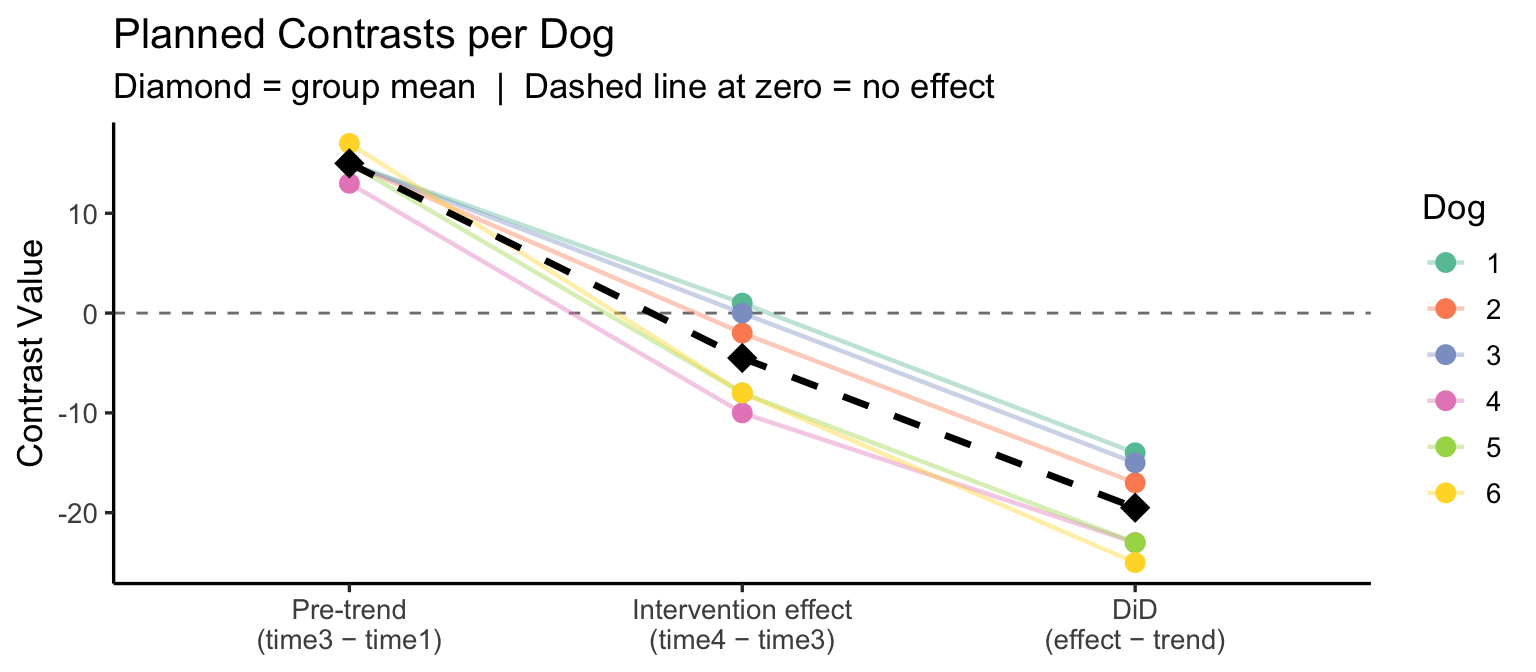
Interpretation:
  • Pre-trend: if not significantly different from zero, histamine was stable at baseline — any subsequent change is more cleanly attributed to the intervention.
  • Intervention effect: compares time4 (post) directly to time3 (at injection) — a significant positive value means histamine continued rising; a negative value means the drug suppressed it immediately after administration.
  • DiD: the cleanest causal estimate — it removes the natural baseline drift from the intervention effect. If significant, the drug changed histamine above and beyond the pre-existing trend.

Fin